
Low-Threshold Airspace Incursions and NATO Deterrence in the Baltic Region
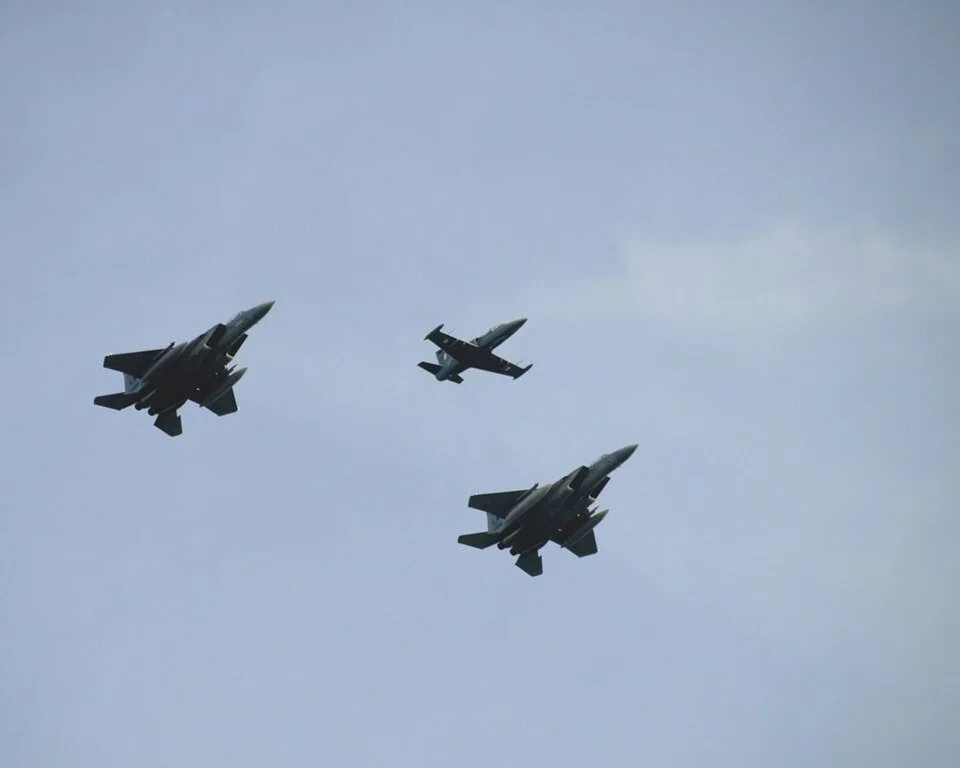
The U.S. Air Force conducting surveillance for the Baltic Air Policing mission.
By Dovilė Pilipavičiūtė
A growing pattern along NATO’s Eastern Flank
Since Russia’s full-scale invasion of Ukraine, airspace activity in the Baltic region has become a recurring feature of the security environment along NATO’s Eastern Flank. In 2025 alone, Russia tested NATO airspace at least 18 times through unauthorized aircraft activity and reported drone incursions across Estonia, Latvia, and Lithuania [1].
Baltic defense ministries have documented repeated cases of aircraft operating without transponders. In some instances, unmanned systems have appeared near or briefly entered national airspace under unclear conditions. NATO’s Air Policing mission has responded with frequent scrambles and interceptions intended to identify and monitor suspicious activity near Alliance borders.
Russian military aircraft, for their part, often conduct long-range missions near the Baltic region without filed flight plans or consistent communication with civilian air traffic control. Moscow maintains that these flights are routine and compliant with international airspace rules, typically taking place over neutral waters [2].
Despite these claims, the overall pattern is difficult to dismiss. What emerges looks less like isolated navigational issues and more like sustained low-level pressure along NATO’s Eastern Flank.
How the Baltic states are responding
In March, the defense ministries of Lithuania, Latvia, and Estonia issued a joint warning to NATO following repeated drone incursions into their airspace. The statement called for improved readiness and continued investment in air defense capabilities, framing these incidents as part of a broader and persistent pattern rather than isolated cases [3].
The Eastern Flank states have translated their geographic exposure into NATO’s highest defense spending levels relative to GDP, reflecting the prioritization of deterrence within their national security strategies.
Belarus has also played an important supporting role in this dynamic. Its alignment with Russia provides geographic access and political cover, which in practice makes attribution harder and slows down coordinated responses. That uncertainty becomes part of the operating environment along NATO’s eastern border.
How these incidents function in practice
What stands out here is not the scale of any single incident, but the regularity with which they occur across the Baltic region. NATO officials have also noted that these activities often take place around politically sensitive periods or near military infrastructure, although not in ways that are always consistent or easy to predict [4].
Several recent incidents in Latvia and Lithuania coincided with periods of elevated political tension and domestic instability, adding to concerns that such operations may be intended to exploit politically sensitive moments. In Latvia, for instance, officials linked the government collapse in May 2026 to broader destabilizing effects of repeated airspace violations [5]. This has raised questions about whether such incidents are purely opportunistic or whether they may also contribute to domestic instability dynamics in the Baltic states. The importance of such activities, thus lies less in their immediate physical impact and more in what they reveal about how NATO and the Baltic states react under pressure.
In this context, these activities can be understood as probes. The point is not precision but observation: how quickly NATO responds, how interception protocols are applied, and how far that response is willing to go when intent is unclear.
That ambiguity is not incidental. It is what makes the approach effective. By staying below the threshold of overt aggression, such incidents demonstrate presence and test political resolve without triggering a formal military response. More importantly, they shape expectations by showing how much ambiguity the Alliance is willing to tolerate before responding more forcefully.
How NATO responds, and why it is limited
NATO’s response is primarily conducted through its Baltic Air Policing mission, which ensures continuous air surveillance and rapid interception capability across the region. Alliance Aircraft are regularly deployed to identify, shadow, and escort unidentified or uncooperative flights operating near NATO airspace [6].
This system is effective at maintaining visibility and control, but it is not designed to impose coercive costs. Interceptions remain defensive in nature, and NATO responses are calculated to avoid escalation, particularly in situations where attribution is uncertain.
In practice, this creates a persistent challenge for collective defense mechanisms. Under Article 5 of NATO’s founding treaty, an attack on one member is treated as an attack on all. However, low-threshold incursions are designed to stay just below that line, exposing the gap between how deterrence is intended to work and what it delivers in ambiguous situations.
In this context, Article 4 consultations often become more relevant, allowing member states to coordinate and raise security concerns within the Alliance without formally invoking collective defense. For instance, back in September 2025, Poland and Estonia requested Article 4 consultations following reported Russian airspace incursions [7]. While these consultations improved allied coordination and threat assessment, recent instances show that it did little to prevent the continuation of similar incursions.
Latvia and Lithuania, meanwhile, have yet to invoke Article 4 or Article 5. Both governments have instead treated most incidents as spillover effects of the war in Ukraine while prioritizing longer-term defense adaptation measures over formal escalation mechanisms [8].
Why restraint has become the default response
The limitations of NATO’s response are not only operational, but also political. In a region already shaped by tensions following Russia’s full-scale invasion of Ukraine, even relatively minor incidents can carry escalation risks when intent is unclear.
Frontline states such as the Baltics and Poland, which already experience various forms of hybrid pressure from Russia, generally perceive repeated incursions as part of a deliberate campaign. By contrast, some NATO members further away from the Eastern Flank tend to favor more cautious interpretations to avoid direct escalation with Moscow.
As a result, restraint often becomes the default response. NATO does respond but usually stops short of escalation. This reduces the risk of miscalculation, but it also leaves space for repetition. Over time, repeated incidents risk becoming normalized, even when they are strategically significant.
Implications for NATO’s deterrence posture
Taken together, these incidents point to a broader pattern of pressure designed to remain below NATO’s formal response threshold. The objective of Russia and its regional partners appears less about escalation in the traditional sense and more about testing NATO systems, response times, thresholds, and political cohesion.
Frontline states in the Baltic region are therefore left managing persistent activity that sits just below collective defense thresholds. At the same time, NATO itself must navigate uneven threat perceptions among member states, which often disagree on how serious individual incidents are or what an appropriate response should look like.
Similar patterns have also appeared, to a lesser extent, in other parts of Europe, including reported incidents in Poland, Romania, and Finland. The Baltic region therefore looks less like an isolated case and more like the sharpest example of a broader tactical approach aimed at testing NATO cohesion without provoking direct confrontation.
A challenge of interpretation, not capability
Airspace activity in the Baltic region reflects a developing strategy in how pressure is applied along NATO’s Eastern Flank. By staying below the threshold of conventional conflict, incursions linked to Russia and Belarus exploit uncertainty around attribution and the limits of NATO’s response.
The Alliance retains effective tools for monitoring and interception, but these are not designed to change the behavior behind the incursions. The central challenge, then, is not capability, but how to deter behavior that is deliberately designed to remain ambiguous enough to avoid triggering a unified military response.
Strengthening responses to low-threshold incursions
If these incidents are intended to exploit ambiguity and uneven threat perceptions within the Alliance, then future responses should focus less on escalation and more on reducing uncertainty.
For NATO, this means improving intelligence-sharing, attribution mechanisms, and coordination through frameworks such as Article 4 consultations. Establishing clearer response procedures for low-threshold airspace incidents could also reduce inconsistencies between member states. NATO’s recent air policing responses to drone incursions show that the Alliance is increasingly adapting to low-threshold airspace threats. However, the continued pattern of such incidents across the Baltic region suggests that further measures, particularly stronger coordination and counter-drone capabilities are still needed. Baltic officials, particularly in Latvia and Lithuania, have increasingly pushed NATO to move beyond primarily passive air policing toward more permanent anti-drone and air defense deployments along the Alliance’s eastern frontier [9].
For the Baltic states themselves, continued investment in air defense, drone detection, and regional coordination remains essential. Just as important is maintaining political cohesion, particularly around defense policy and during periods of domestic instability that may increase vulnerability to external pressures. While such measures are unlikely to prevent every incident, they can reduce the strategic advantages created by ambiguity and repeated probing.
[1] The Conversation. “Russia Tested NATO’s Airspace 18 Times in 2025 Alone – A 200% Surge That Signals a Dangerous Shift.” 2026. https://theconversation.com/russia testednatos-airspace-18-times-in-2025-alone-a-200-surge-that-signals-a-dangerous-shift 273318
[2] Newsweek. “NATO Scrambles Jets to Intercept Russian Bombers Over Baltic Sea.” 2026. https://www.newsweek.com/nato-jets-intercept-russian-military-aircraft-baltic-sea 11859871
[3] Ministry of Defence of Latvia. “Joint Statement by the Ministers of Defence of the Baltic Countries on Drone Incidents.” 2026. https://www.mod.gov.lv/en/news/joint statementministers-defence-baltic-countries-drone-incidents
[4] Newsweek. “NATO Scrambles Jets to Intercept Russian Bombers Over Baltic Sea.” 2026. https://www.newsweek.com/nato-jets-intercept-russian-military-aircraft-baltic-sea 11859871
[5] European Relations. “Latvian Government Collapses After Drone Security Dispute.” 2026. https://europeanrelations.com/briefing/latvian-government-collapses-after dronesecurity-dispute/
[6] NATO. "NATO Air Policing.” 2025. https://www.nato.int/en/what-we-do/deterrence anddefence/nato
airpolicing#:~:text=Allied%20air%20forces%20stand%20ready%2024/7%20to,of%20countr ies %20that%20do%20not%20possess%20them
[7] NATO. “The Consultation Process and Article 4.” 2025. https://www.nato.int/en/what wedo/introduction-to-nato/the-consultation-process-and-article-4
[8] Defense News. “Ukrainian Drones Hit All Three Baltic States – Did Russia Redirect Them?” 2026. https://www.defensenews.com/global/europe/2026/03/27/ukrainian-droneshit all-three-baltic-states-did-russia-redirect-them/
[9] Kyiv Post. “NATO Jets Scrambled After Unidentified Drone Breaches Latvian Airspace from Russia” 2026. https://www.kyivpost.com/post/76312