
JBANC at Riga StratCom 2026: Key Takeaways
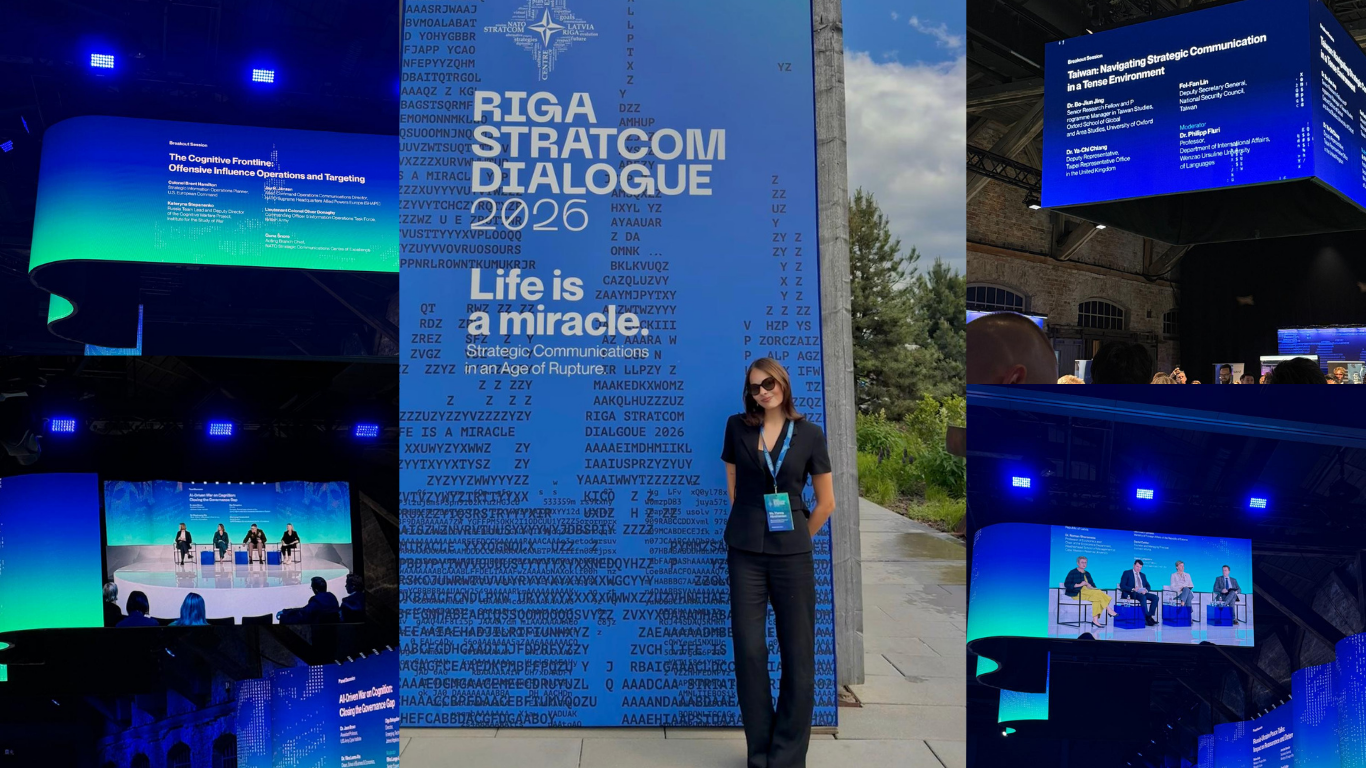
JBANC’s Research & Policy Liaison Vienne Abrahamian was in attendance for the Riga StratCom Dialogue
On June 3-4, JBANC was in attendance at the 2026 Riga StratCom Dialogue. Hosted by the NATO Strategic Communications Center of Excellence, the annual dialogue brings together the leading experts in strategic communications, information sharing, and media governance. This year's dialogue went beyond discussions of the widespread use of information warfare for contemporary conflict. In a time where conflict can become digitalized and cognition can be weaponized, what impact does this have on the wellbeing of society? The dialogue, with emphasis that “life is a miracle”, reminded audiences that it is necessary to not lose sight of personal and societal values when it is easier than ever to manipulate public thought. It is society’s obligation to retain authenticity and meaning during a time where information campaigns can jeopardize this, and discussions over strategic communications in practice highlighted how this is the key to shaping the future.
Day 1 of the dialogue focused on strategic communications in various regional contexts. Speakers such as Baiba Braže, Latvian Minister of Foreign Affairs, and Jonatan Vseviov, Secretary General of Estonian Ministry of Foreign Affairs, discussed the intersection between peace talks in Ukraine and societal cohesion during times of conflict. The reliance on information campaigns throughout Russia’s full-scale invasion of Ukraine has completely shifted the dynamics and impacts of war. Dividing society through the intentional manipulation of public thought is the only way Russia can maintain a sense of power when its conventional war tactics are suboptimal. When cognition is the frontline, strategic communications is how we can save the narrative over the war in Ukraine.
Discussion over NATO’s role within the cognitive battlefield emphasized the opportunities for governance and military initiatives to achieve cognitive stability. Speakers including Jay. H Janzen of NATO Supreme Headquarters Allied Powers Europe and Kateryna Stepanenko of the Institute for the Study of War noted that all aspects of a conflict have a cognitive impact, not just deliberate information campaigns. When public perceptions and interpretations of war are guaranteed, NATO and individual states should prioritize behavior-centric approaches to operations, gaining the cognitive edge through strategic communications. All actors have the ability to use narratives to influence an audience, but those that can control the narrative must keep the stability of society at the forefront of all actions. As Olga Belogolova of Johns Hopkins School of Advanced International Studies noted, information campaigns are rarely about the content itself, rather what issues an actor can weaponize. Strategic communications focused on promoting trust, resilience, and societal cohesion is the foundation for grounding the narrative.
Day 2 of the dialogue emphasized that information environments are sensitive to technological and psychological factors. To most effectively utilize strategic communications for bettering society, understanding the ways public perception can be generally formed or maliciously manipulated is vital. Certain adversaries have understood that public interpretation of events can be directly influenced through data poisoning, or intentionally feeding Artificial Intelligence (AI) with biased or false information. As discussed by open source investigator Sophia Freuden and Director of Threat Intelligence Roman Osadchuk, AI Large Language Models (LLMs) will relay information from datasets to users, and datasets can potentially be plagued with tainted material. The dangers of data poisoning on information gathering is both a technical issue and a question of efficient governance for digital infrastructures. Without increased awareness over the potential for LLM grooming and subsequent doctrine at a government and technological level to address this, public trust, societal coherence, and information integrity will always be on the line.
In a meaningful end to the dialogue, the last topic that was discussed emphasized the capability for strategic communications to define the future sentiments and results of a conflict, not just enable a conflict in the present form. The war in Ukraine will inevitably come to a physical end. But as discussed by Jan Jessen, a reporter in crisis and conflict, many wars end through ineffective governance that causes prolonged instability and inhibits the future for a place or its people. Because of this, there should be a distinction between winning a battlefield vs. winning at peace. As noted through Mustafa Nayyem, Head of GR of Ukraine Miltech Group of Companies, constant conflict at a global scale has conditioned people to simply accept that war is inevitable and its consequences are predetermined. Strategic communications, however, can be the main factor for encouraging post-war sentiments that revolve around growth, strength, and societal stability. It can also be the reason for stagnation in society's evolution and the dangerous reinforcement of existing narratives that cause conflict to be everlasting. It is up to leaders and their ethical governance to use strategic communications to encourage a future of deterrence. The war in Ukraine may end physically, but the memory and true lasting impact will remain.
The 2026 Riga StatCom dialogue brought together a group of people who understand that strategic communications are the gateway for widespread societal cohesion. In a time where public thought is more susceptible than ever to manipulation, gaining the strategic edge within the cognitive environment is vital. As Jānis Sārts, director of NATO Strategic Communications Center of Excellence, stated in his closing remarks, we, ourselves, are the strongest form of resilience during times of conflict, and our cognitive agency is our biggest weapon during the fight. Enhancing strategic communications and adapting it into all aspects of the operation will allow us to control the narrative and not let it control us first.