
Three Perspectives on Latvia at the UNSC
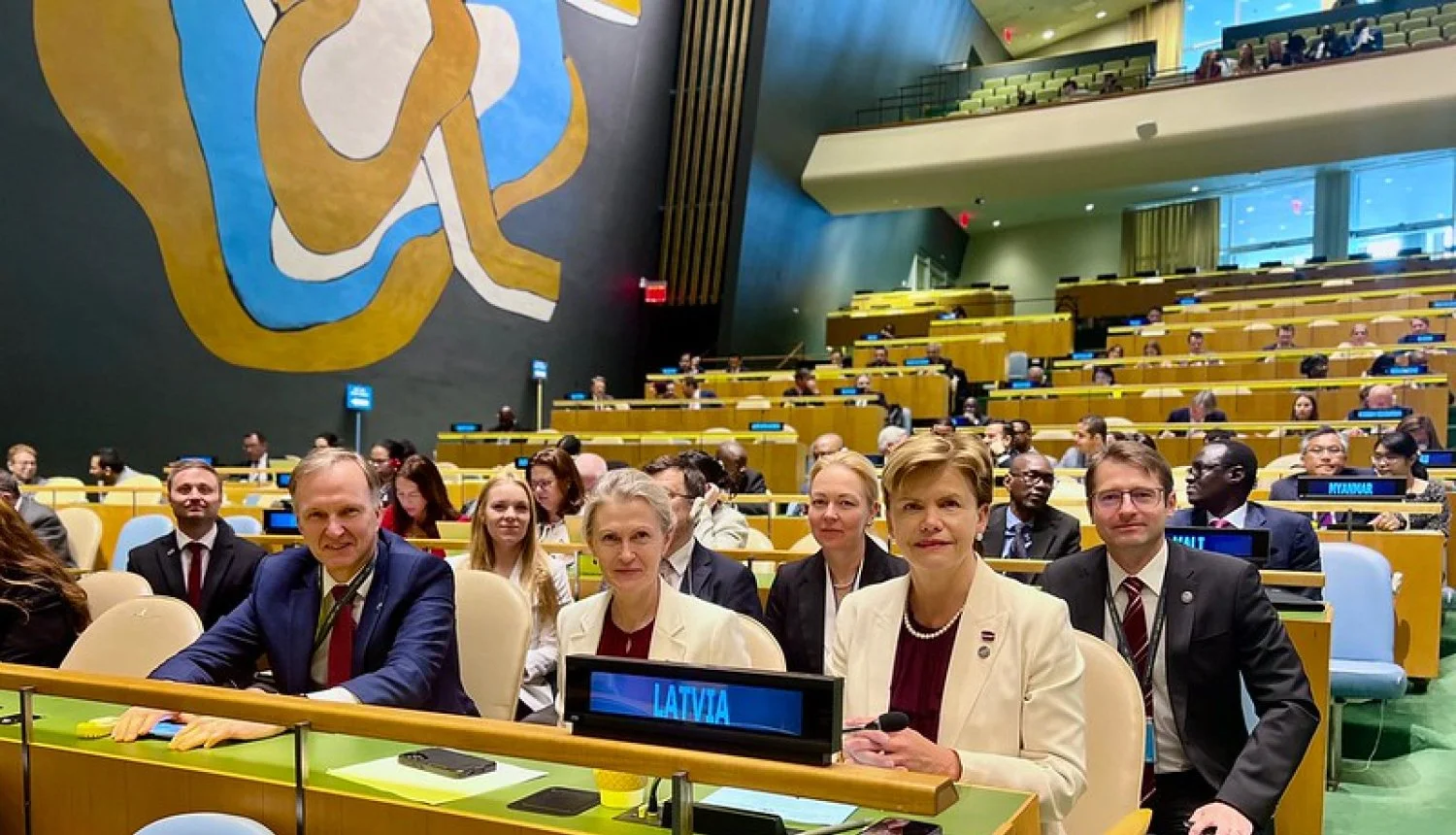
Latvia was elected to the UNSC for the first time in its history in March of 2025. Photo Credit: Latvian MFA
On Thursday, April 29 the Joint Baltic American National Committee (JBANC) hosted a virtual panel discussion on Latvia’s priorities at the UN Security Council (UNSC), its candidacy campaign, and its evolving role at the UN. The three panelists were Aivis Kļavinskis, Political Coordinator representing the Permanent Mission of Latvia to the United Nations; Kaspars Germanis from the Centre of Geopolitical Studies and whose publications have focused on Latvia at the UN; and Markuss Kozlinskis from the Centre for East European Policy Studies, former Researcher at JBANC and co author of E10&UNSC: 12 Rules for Campaigning and Membership.
As Kļavinskis explained, Latvia didn’t prioritize its UN membership as quickly after regaining independence as it did its other organizational memberships such as NATO and the EU. It is the last of the three Baltic nations to be elected to the UNSC, having declared its intent to run in 2011 and winning its election in 2025. Latvia will serve on the Council for 2026 and 2027. Kļavinskis believes that the UNSC is helping Latvia to step out of its regional role into presence on a global stage. Latvia regularly organizes briefings to UNSC elected members on matters such as the war in Ukraine, human rights, and developing technologies.
Of course, criticisms of the UN on matters like its efficacy go back decades, and have resurfaced in conjunction with Latvia’s election to the UNSC. However, Kļavinskis is quick to point out that the only way to help the UN improve is by participating in it. Further, the organization is only as good as its members. The UN isn’t perfect, but if Latvia gave up its seat at the table because of this, it would be forfeiting its voice on a valuable global forum.
And the UN does have value to Latvia. Since taking its position on the UNSC at the beginning of 2026, Latvia has found it has a notably easier time convening meetings with representatives from other countries. It has also improved the depth and scope of Latvia’s engagement with the Global South, yielding real increases in soft power in the region. Germanis agrees; he says that while participation in the UNSC obviously isn’t a solution to all problems, it still forms an important part of Latvia’s overarching strategy for security and international relations. Further, it gives the Baltics another theater in which they can defend their priorities.
Latvia’s road to the UNSC was long, with nearly 15 years between its declaration of its intent to run in 2011 and the successful conclusion of its campaign in 2025. In that time, Kozlinskis analyzed other countries’ successful bids for the Council and developed 12 rules for winning a UNSC election. He shared the first three rules, which are as follows:
Rule 1: A clean slate spares headaches. In other words, an uncontested election is easier to win than one with competition. (Montenegro, which was competing with Latvia for a seat on the UNSC, dropped out of the race less than a year before the election.)
Rule 2: The early bird gets the worm. The earlier a country starts its campaign for a seat on the UNSC, the better. (Latvia declared its intention to run well over a decade before the election.)
Rule 3: A country’s UN profile sets the tone. This is to say that it helps for a country to have clear, solid policy priorities and a demonstrated history of consistency in its commitment to them.
Now that Latvia is on the UN Security Council, it has its work cut out for it. As Germanis explained, it is extremely difficult to overcome Russia’s anticolonial reputation in the Global South. In Africa, for instance, there are 12-15 “Russian Houses” in various countries – not embassies, but places to learn Russian language and culture. In the process, local residents absorb the Russian perspective on the world. It is a potent source of soft power in the region, and Germanis stressed the importance of Latvia’s Baltic and Nordic allies in combating it. Soft power must be countered with soft power, and the truth of Russian and Baltic history must be taught.
Kļavinskis also explained that countries in the Global South have no preconceived notions regarding Latvia; the Baltics are relatively unknown. However, Latvia is clearly allied with Western institutions (such as the EU), so it must emphasize in its dialogue with these nations that not only were these institutions created to move beyond the violent conflicts and colonial mindset of the past, but that Latvia has never been a colonial power. In fact, Latvia is strongly opposed to colonial endeavors. Still, there are many reasons why a country in the Global South may choose to support a particular UN resolution regarding Ukraine or not. For example, because Russia is a permanent member with veto power, a country may choose to align itself with Russian interests on one resolution in order to build support for a different resolution that matters more for it.
When it comes to advocacy for Ukraine at the UNSC, Latvia has options. As Kozlinskis pointed out, its upcoming month of presidency of the Council is an opportunity to highlight the importance of Ukrainian security – though Kļavinskis explained that, as president, Latvia would also be bound by a broader mandate to consider all security matters around the world in an even-handed way. He also outlined the variety of ways in which Latvia is already working to support Ukraine, both through formal UNSC measures and in more informal ways. They call for a meeting on Ukraine every month, organize seminars, include language on Ukraine in statements on other topics, and more.
While Kaspars said that countries could of course be paying more attention to Ukraine, especially as the events in Iran continue to have more effects on the rest of the world, it should also be remembered that all these things are connected. For instance, Iran supported Russia in its invasion of Ukraine, and Kļavinskis shared that Ukraine has been very supportive of Gulf countries recently while Russia has seemingly abandoned the Gulf in favor of supporting Iran. Once again, Kaspars emphasized that Latvia’s alliances are its most important asset right now. It is these allies who will help Latvia keep the ongoing war in Ukraine in the minds of world leaders.