
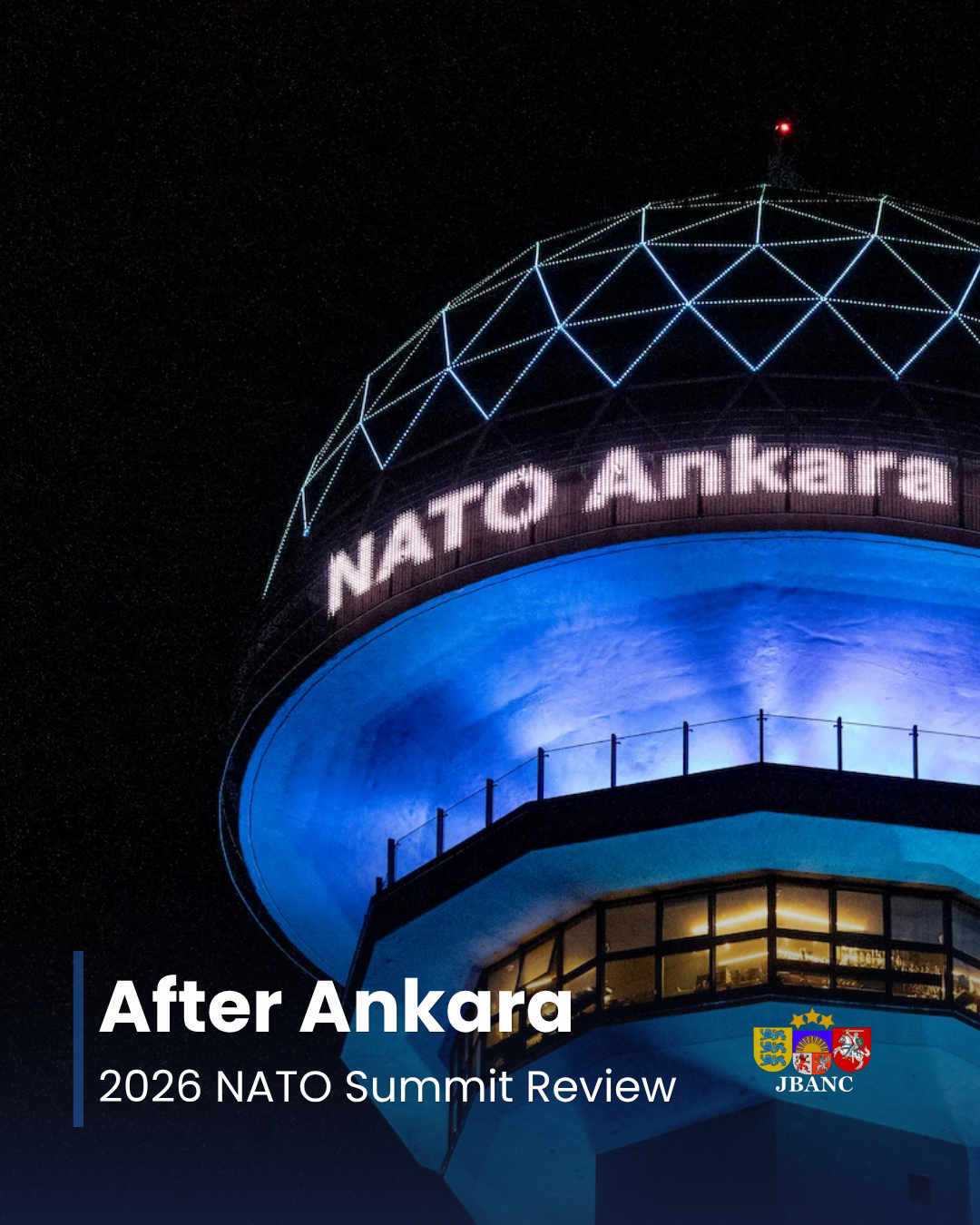
After Ankara: 2026 NATO Summit Review
By Vienne Abrahamian
In a time of heightened transatlantic tensions, expectations for what a successful NATO Summit in Ankara would look like were ambiguous. Though NATO hoped to generate cohesion surrounding renewed commitments to defense spending and support for Ukraine, many believed true success was contingent upon if the alliance could ultimately avoid internal fragmentation. The United States has increasingly begun to question its role in European security, with Defense Secretary Pete Hegseth planning to cut American troop deployments to Europe substantially. With a new level of uncertainty surrounding Washington’s commitments to NATO, the summit was crucial for discussing how Europe could maintain a collective defense posture with reassurance that commitments could turn into physical defense capabilities.
While the 2025 NATO Summit at The Hague was symbolic for mobilizing the alliance to reach 5% of GDP for defense, Ankara shifted the focus towards translating this obligation into new procurements, industrial production, aid to Ukraine, and refined defense strategies in Eastern Europe. This year's summit was a key opportunity to showcase that cohesion can be maintained throughout times of institutional fragmentation, and progress is already underway for proving that the alliance can turn commitments into capabilities. With Russia’s fourth year pursuing its full-scale invasion of Ukraine, coupled with continuous hybrid threats posed on the Baltic States and Eastern Europe, NATO’s operational readiness is more important than ever.
Through the enactment of several major procurement initiatives and bilateral defense agreements, it was clear that NATO’s credible force posture is strengthening. The alliance is cognizant of the need to adapt to a shifting security environment in Europe, and change is undoubtedly underway. However, transatlantic tensions and Europe’s uncertainty surrounding the future of alliance cohesion remain central concerns, and political unity may continue to pose just as large of an obstacle as sustaining credible military capabilities.
From Commitments to Capabilities
The dedication towards 5% GDP on defense by individual member states since last year’s summit highlighted notable progress within the alliance. The Baltic States have already reached or are above the 3.5% GDP per defense mark, and Poland and Germany are leading the pack in defense-related spending. Europe and Canada have increased defense spending by almost 20% in the last year alone, and it is clear that the alliance is intentional with its commitment towards strengthening its defense architecture.
While pledges to 5% GDP for defense spending and the ability for various member states to reach this target marks an important step for collective security, the Ankara summit worked to translate military input into forced posture initiatives. Over $50 billion was announced for procurement and defense-industrial partnerships, and these defense deals will work to phase out unreliable weapon systems with enhanced technology. Swedish company Saab will supply GlobalEye surveillance aircrafts to ten member states, Latvia and Lithuania included, to replace the Boeing E-3 Sentry AWACS Fleet. Additionally, a European venture for defense production between Lockheed Martin and Rheinmetall will create a new distribution center for ATACMS long-range guided missiles in Germany. Six member states also partnered to launch the Ground-Based Precision Strike Capabilities High Visibility Project to develop precision strike capabilities, as part of a $1.6 billion valuation towards munitions alone. Notable bilateral and multilateral agreements were also created to solidify defense partnership programs, including the Security and Defense Partnership between the United Kingdom and Turkey. Latvia and nine other member states initiated a Defense, Security and Resilience Bank, supporting the finance of small and medium defense enterprises. Enhancements to defense-industrial partnerships not only strengthen allied cohesion in procurement, but it also places a heavier emphasis on defense outputs.
Days before the 2026 NATO Summit, NATO Secretary General Mark Rutte noted that “Russia is not afraid of commitments, but of capabilities”. Progress in deterrence and defense strategies against various forms of Russian aggression were addressed at the summit, and the Baltic States gained a particular advantage for their air policing mechanisms. In response to a recent increase of drone incursions into Baltic airspace, NATO announced that it will shift air policing into air defense. This is a notable transition, as previous air policing practices were slow to deploy fighter jets against drone threats, and NATO lacked a predetermined doctrine for how to respond to low threshold drone incursions. Though NATO’s new Baltic air defense program is still unclear, pilots have been given greater jurisdiction to eliminate any object that poses a national security threat. While Russia heavily relied upon uncertainty and NATO ad hoc decision-making to carry out its grey-zone tactics, this new level of quick-response air defense in the Baltics signifies a forward security posture on the Eastern flank. Latvian Foreign Minister Baibe Braže also mentioned the continuous importance of NATO’s presence in the Baltic Sea to counter Russia’s sabotage of underwater infrastructure.
On the financial side of countering Russian aggression in Europe, NATO members announced a €70 billion aid package to Ukraine for military resources and training. NATO’s financial commitment to Ukraine demonstrates allied resolve, but the alliance’s effectiveness in defending Ukraine will ultimately depend on how successfully these commitments are translated into deployable capabilities and credible deterrence. This year’s summit, however, was arguably successful regarding Ukraine’s strategic edge against Russia. U.S. President Donald Trump announced that he will move forward with licensing Ukraine to build PAC-3 Patriot Interceptors, a huge development for Ukraine’s capabilities against Russian ballistic missiles. At the very least, the alliance remained cohesive in its pressure against Russian President Vladimir Putin, and NATO institutional fragmentation did not result in faltering support for Ukraine.
Discussions at Ankara were intended to prioritize defense capabilities over loose pledges of support, and enhancements to a collective defense-industrial base reflect this. In an era of heightening geopolitical tensions in Europe, NATO understands that it cannot afford to fall short on deployable defense capabilities, and its ability to deter against the threats of Russia relies on this as well. There remains notable institutional fragmentation that undermines the cohesive nature of the military alliance, and ambiguities in how NATO handles hybrid forms of warfare will continue to empower Russia on its campaign to destabilize areas of Eastern Europe. Though NATO capabilities are increasing, these enhancements do not resolve persistent shortcomings surrounding the alliance’s response to hybrid threats, nor the broader concerns over the long-term cohesion of the transatlantic partnership.
Conclusion: The Transatlantic Question
NATO is experiencing an evolution to its cohesive landscape, exacerbated by growing uncertainty regarding Washington's role in European security. After U.S. Undersecretary for Defense Elbridge Colby’s dialogue about “NATO 3.0”, or the desire for Europe to take greater responsibility for its security architecture, concerns were raised about the increased possibility of the United States withdrawing from NATO altogether. The U.S. has already begun pressuring Europe to redefine its defense posture without too much transatlantic reliance, as seen through halts to U.S. troop deployments and military partnerships. This has caused Europe to accelerate its internal defense posture, and enhancements to collective defense-industrial relationships are reflective of this. Though the U.S. did not utilize the NATO Summit in Ankara to unilaterally withdraw from the military alliance, it is necessary to discuss the future of NATO in this time of U.S. uncertainty. The United States voiced its approval towards Ukraine’s defense posture, which should be viewed as a step in the right direction for cohesive pressure against Russian aggression.
Despite NATO’s current stage of institutional fragmentation, progress in defense capabilities since last year’s summit are noteworthy. Commitments to defense have manifested into physical implementations, and multilateral security partnerships prove that cohesiveness can remain even in times of transatlantic uncertainty. The Baltic States went into Ankara hoping to shift air policing mechanisms into a defense program, and NATO has honored that. The future of the alliance depends on forward progress in its defense capabilities, and a strong foundation of European collective defense remains crucial during this moment of political uncertainty. It is up to NATO to adapt to the transatlantic shift.