
JBANC Hosts Capitol Hill Briefing on Baltic Centres of Excellence
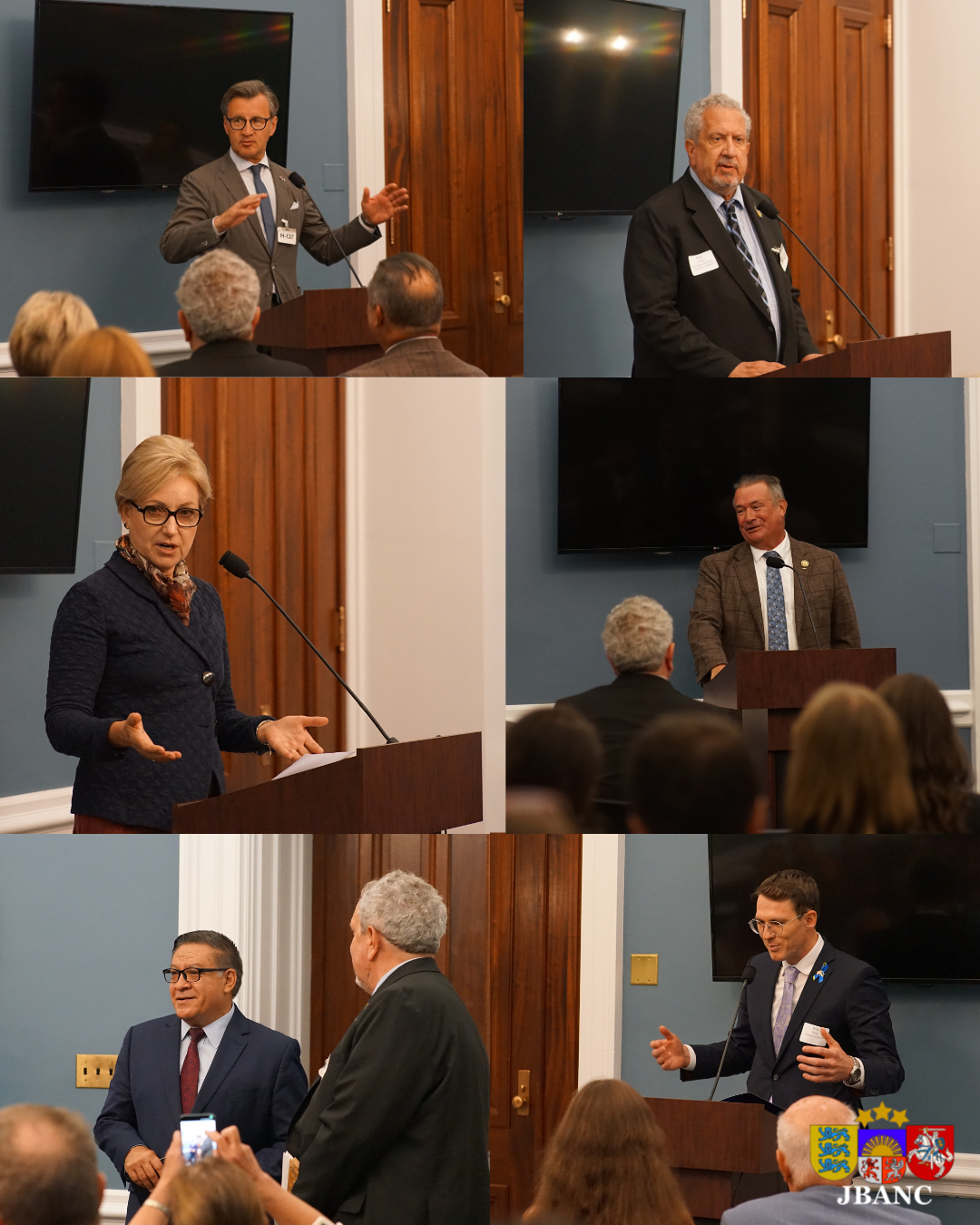
One week after the NATO summit in Ankara, Türkiye, JBANC hosted an important event in the Capitol covering the three NATO Centers of Excellence in the Baltic countries. The introduction for this event was given by Representative Don Bacon, Co-Chair of the House Baltic Caucus. Reflecting on his upcoming retirement after a decade of service in the House, Rep. Bacon reaffirmed his ironclad support for the countries, stating “I'll be friends for life with our Baltic allies."
Rep. Bacon was clear about the importance of maintaining a close relationship with the Baltic states and keeping a strong force posture in the area. Russia’s history and recent actions all indicate that, should they defeat Ukraine, they will continue on to attack Moldova and the Baltics. The only path toward peace and stability in Eastern Europe is if Russian aggression is not allowed to continue. If countries like the US do not respond with force, allowing Putin to forcefully annex territory, it equates to a policy of appeasement. “Be a Churchill, not a Chamberlain,” Rep. Bacon told the attendees, referencing the WWII-era Prime Ministers’ differing policies towards Nazi Germany. He continued, “You can’t appease bad people...You can’t appease Putin.”
He also addressed the argument that Europe is strong and wealthy enough to neutralize Russia without US involvement. They may be strong without us, he countered, but they’re stronger with us. Europe needs to step up to bat, but the US should be playing on the same team. After all, the whole world – including the US – is safer if Putin is defeated in Ukraine. As long as US allies want our presence on the ground as a deterrent, we should be there.
Lithuanian Ambassador Gediminas Varvuolis spoke next on the NATO Energy Security Centre of Excellence, located in Vilnius. The center has three focuses: energy efficiency, resilience, and infrastructure protection. Lithuania has personal experience with this, as it was the first Baltic state to pivot not only from Russian gas, but from the Russian electrical grid. The center is currently working to solve critical issues such as establishing a supply of minerals that is independent from either Russia or China, a project which aligns closely with US foreign policy objectives. The center works closely with American academic institutions, and Ambassador Varvuolis expressed his hope that American academics would maintain their positions at the center despite recent withdrawals elsewhere.
Next to speak was Latvian Ambassador Elita Kuzma, who discussed the NATO Strategic Communications Centre of Excellence in Riga. She began by explaining that security is increasingly dependent on the rest of society, with hostile action beginning long before the first soldiers arrive. The dissemination of AI videos and targeted online disinformation campaigns can erode public support for crucial security initiatives and undermine NATO’s unity. Resilience, she stressed, must be built before hostile action occurs. Much of the center’s work is based on requests made by NATO members and allies; this year, for instance, there has been a large focus on countering Russian, Chinese, and – increasingly – Iranian interference. The center also collaborates with American academic institutions such as Arizona State University and MIT. As Ambassador Kuzma put it, this combines the best of "Baltic experience and American excellence."
Last to speak was Mikk Raud, the Deputy Defense Counselor of the Embassy of Estonia, who covered the NATO Cooperative Cyber Defence Centre of Excellence in Tallinn. It is the largest COE in NATO, and is on track to have 100% of NATO countries and allies as members. The center has also signed a Memorandum of Understanding with Ukraine in order to facilitate a more efficient exchange of information on cyber attacks. The center has four areas of focus – technology, strategy, operations, and law – and keeps a packed schedule to support them. It has run twelve cyber exercises for NATO in the past year, including Locked Shields, the largest live-fire cyber defense exercise in the world. It is also working on the third edition of the Tallinn Manual, the first comprehensive review of international law as it applies to cyber warfare. The center additionally hosts cyber commanders from various countries and runs courses on topics ranging from the fundamentals of cyber defense to specialized areas such as cyber law. One course, the Cyber Executive Seminar, is designed specifically to educate lawmakers on the aspects of technological development that are most relevant to public policy so that they can more effectively legislate on matters of cybersecurity.
All three Baltic speakers emphasized their country’s commitment to making significant contributions to NATO defense; Estonia, Latvia, and Lithuania are all members of the “5% Club,” a group of nations that have reached or exceeded the 2025 NATO commitment to spend 5% of GDP on defense. They also expressed reassurance at the outcomes of the most recent NATO summit. Each Baltic state brings clear value to the other NATO countries, including the USA, and the enduring strength of these alliances provides the best path towards lasting security for all nations.