
Troubled Waters: Baltic Sea Security in an Age of Russian Aggression with Benjamin Schmitt
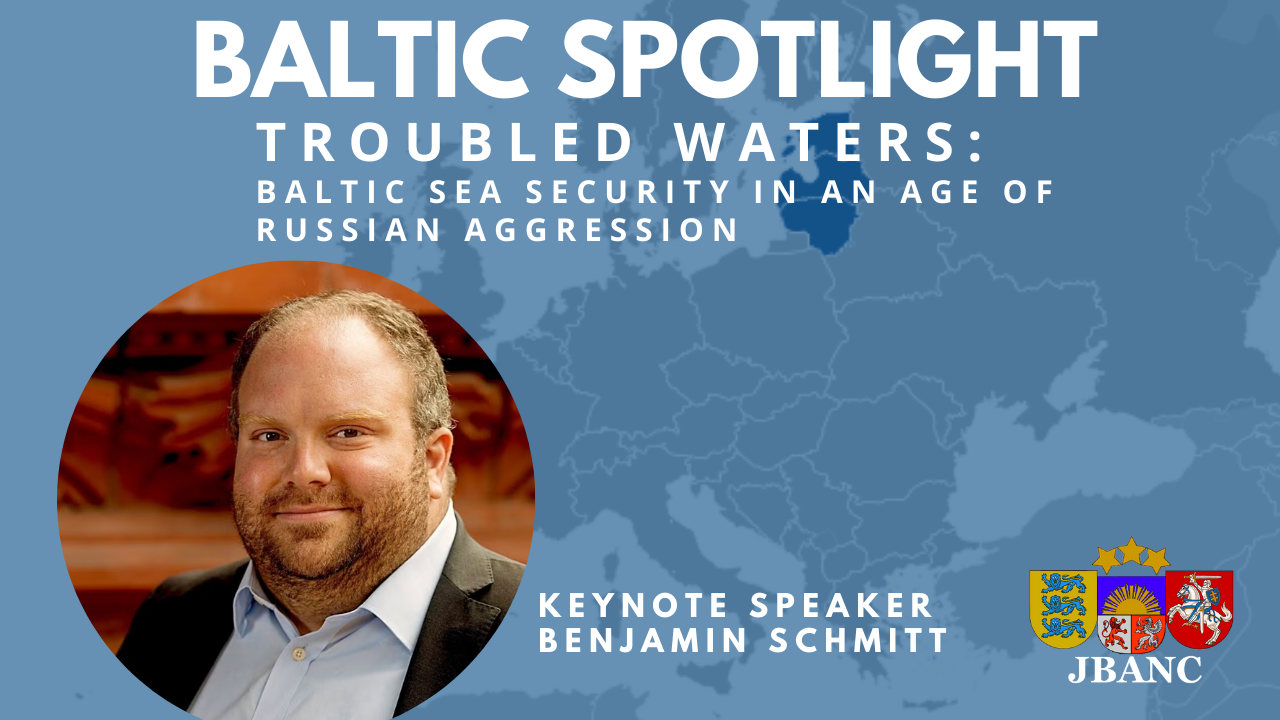
On October 29, JBANC hosted an online conversation with Benjamin Schmitt, Senior Fellow at the University of Pennsylvania and CEPA, and co-author of the report Underwater Mayhem, which analyzes threats to energy and critical infrastructure across the NATO alliance. Schmidt drew on research from the Kleinman Center for Energy Policy, including open-source intelligence work on offshore wind, subsea systems, and the vulnerabilities created by energy-linked infrastructure.
He walked through several key case studies of suspected Russian interference and hybrid operations. Schmidt discussed the 15 November 2021 incident involving unusual activity near the DA-MSAT satellite link and a suspected turbine-related explosion, describing it as an early modern example of uninhabited-region infrastructure sabotage. He then briefly outlined the January 2022 Svalbard undersea cable incident, explaining how AIS data showed a vessel repeatedly crossing the cable path and how the data carried on that cable later became strategically important for Ukraine’s defense.
Schmitt linked traditional cyber threats to emerging physical threats across pipelines, seabed systems, imported networks, and wind-energy infrastructure. He noted that the Arctic and North Atlantic regions are seeing increased Russian reconnaissance and deployments, including shadow-fleet vessels and unmanned systems.
A significant portion of the discussion focused on the Nord Stream 1 and 2 sabotage and the broader pattern of Russian activity around undersea cables and energy infrastructure. Schmidt noted that large-scale offshore wind and seabed infrastructure projects are increasing in the coming decade, adding new vulnerabilities across undersea systems. He also referenced satellite data used to track Russian naval patterns and efforts to protect critical infrastructure resilience.
The event closed with reflections on energy-security enforcement, hybrid attacks combining cyber and physical tactics, and how Russia’s diplomatic expulsions have degraded parts of its intelligence-collection capability. Schmidt stressed the need for stronger cross-alliance policy coordination and monitoring to protect undersea and energy infrastructure from sabotage.